
Physical AI Solutions
We verify equipment move-in and installation, robot motion and worker motion by simulation before implementation, and provide decision material as numbers. Below are demonstrations of each function.
Pre-verification of equipment move-in and installation
Before equipment is moved in and installed, aisle width, openings and floor load are verified in 3D, and the feasibility of the move-in and any obstruction points are reported as numbers. The clip is a verification example in a 24 m × 12 m factory hall (shutter door width 3.6 m, five large machines). A 1,600 mm wide machine passed the 2.0 m aisle and reached its installation position; a 2,400 mm wide machine was judged unable to pass (maximum passable length 1,800 mm).
The route and the verdict are output of our in-house move-in route verification engine. The factory exterior is a 3D model built to the same dimensions used for the verdict.
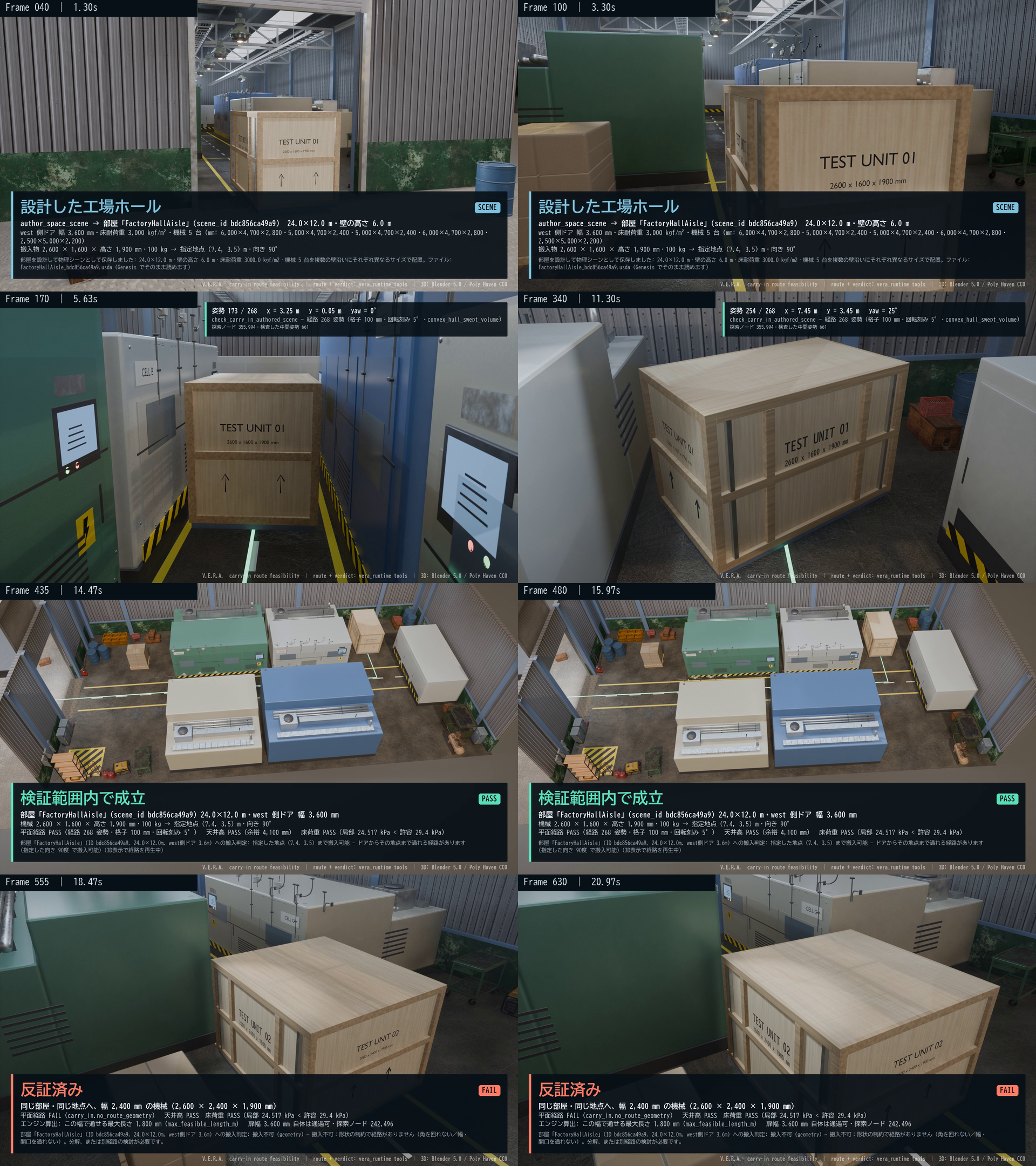
Key frames of the video (with verdict values)
- Overview
- From the dimensions of rooms, aisles and openings and the dimensions of the equipment, we verify whether a passable route exists from the entrance to the installation position. Ceiling height and floor load are checked together.
- Input
- Drawings or a dimension list, on-site measurements (with measured surface and date), equipment dimensions and mass, dolly height
- Output
- Feasibility of the move-in. If not feasible, the obstruction point and the missing dimension. Points with reference values only are reported as “undecidable”.
Pre-verification of robot motion
A model of a robot arm (SO-101, 6 axes) is loaded into a physics simulation, and joint range and self-interference are verified before the motion program is executed. In the clip, self-interference is detected during a folding motion, and the physics engine also stops the arm on contact. Commands beyond the joint range are detected and corrected to within range before execution.
Joint angles and verification results are measured values from the simulation. The work cell exterior is a 3D model.
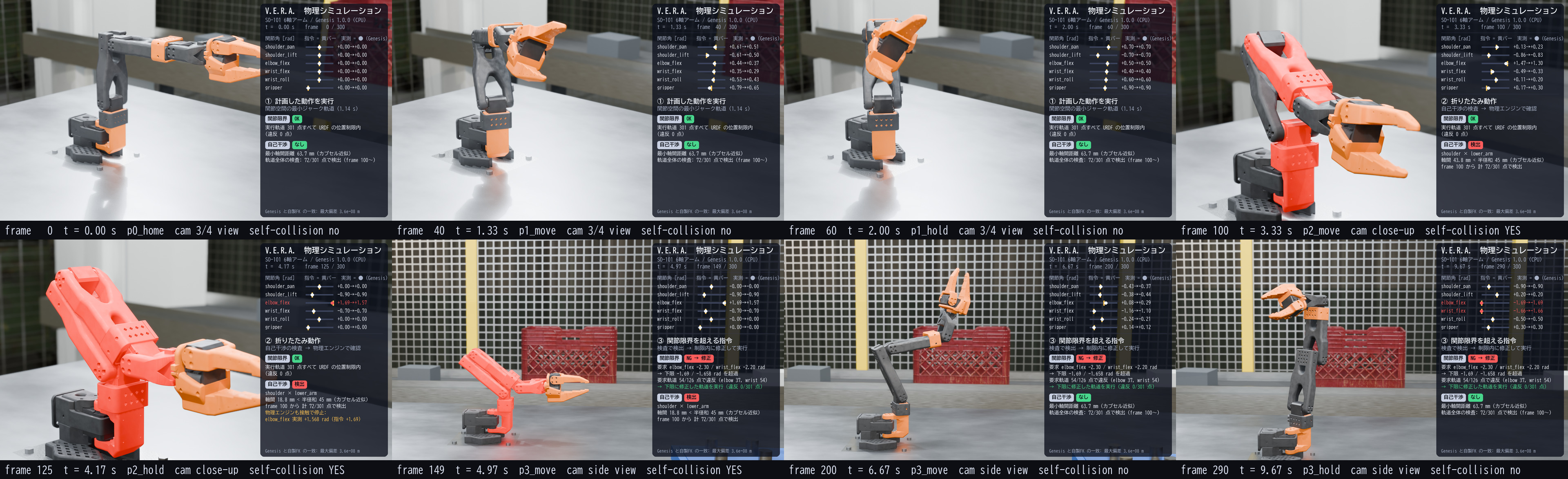
Key frames of the video (with joint command and measured values)
- Overview
- From the robot model and motion commands, we verify joint range, self-interference, abrupt motion (jerk), contact with the floor, and tipping and support conditions before execution. Each verification item runs on 134 in-house verification programs and 1,460 tests.
- Input
- Robot model (URDF), motion commands or trajectory
- Output
- Results per verification item and the first point of failure. Commands beyond the joint range can be corrected and executed.
Move-in study report
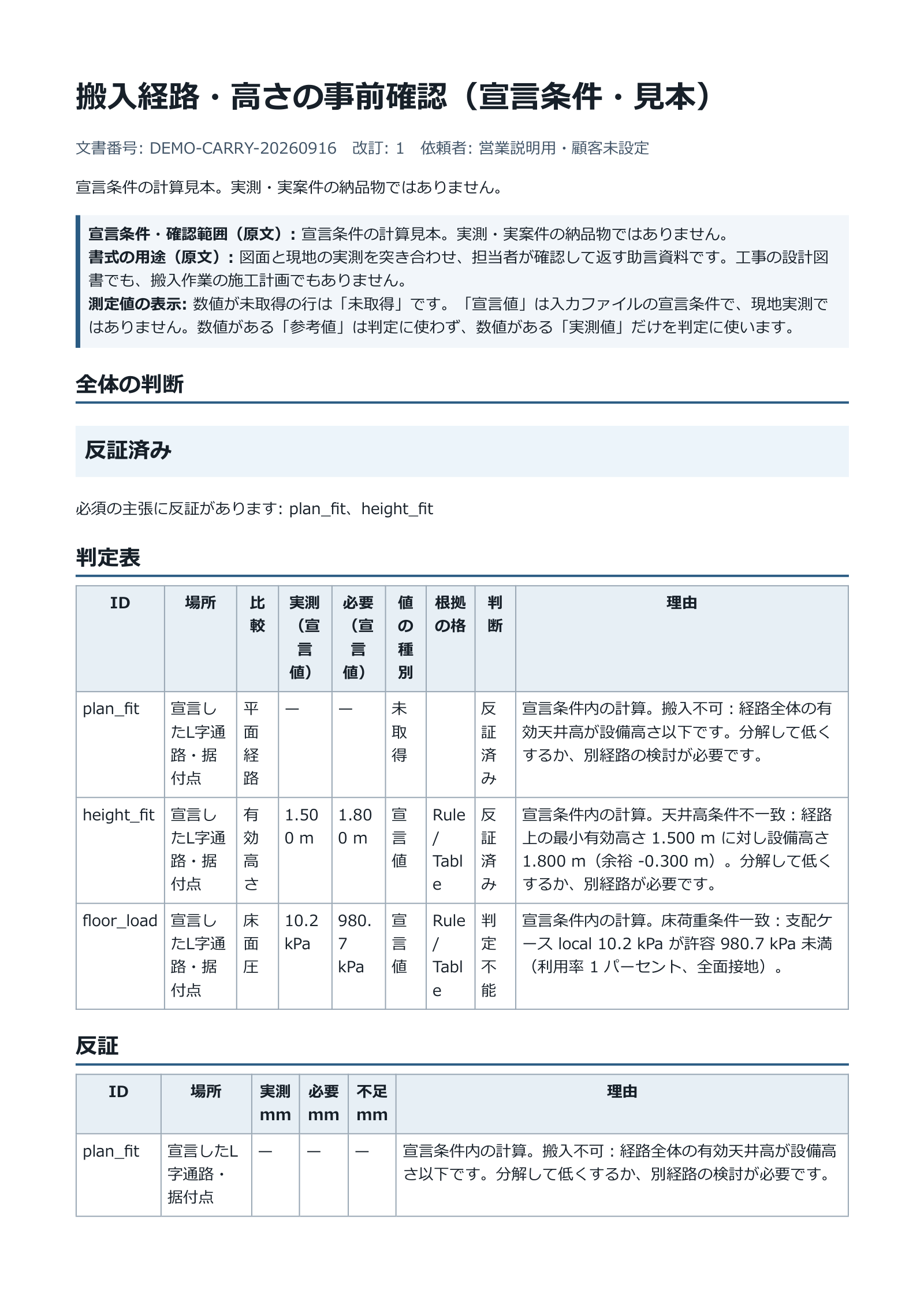
The sample is a calculation example under declared conditions.
Verification results are output as a study report that the person in charge checks and approves before use. The verdict is one of four categories: holds within the verified scope, refuted, undecidable, or invalid input. Missing dimensions, unmeasured points and the expiry date are stated. The final decision is made by a person.
- Overview
- Verification results are compiled into a study report that the person in charge checks and approves before use.
- Contents
- Overall verdict (one of four categories), verdict table (location, compared item, measured value, required value, reason), list of refutations, unconfirmed items, approval field, expiry date and invalidation conditions, identifier of the input data (for tamper detection)
3D capture of the site
- Overview
- A 3D model of the site is created from a video taken while walking with a smartphone, and move-in, installation and robot placement are studied within it.
Work analysis and skill transfer
- Overview
- A skeleton is overlaid on work videos, and angles, positions, order and timing are quantified. Experienced and new workers can be compared at the same phase. It is in use for HAGANE (BIG3).
A skeleton is estimated from a deadlift video taken with a smartphone, and trunk lean angle, knee joint angle and the position of the bar relative to the joints are quantified for each repetition.
Output is limited to observable facts. No pass/fail judgment, no injury prediction, no joint load estimation. This is not a medical service or a diagnosis.
All videos and figures shown are actual output from our in-house systems. No images or videos generated by generative AI are used.
Verdict categories
No refutation was found within the drawings and measurements provided. Nothing is judged outside that scope.
A refutation was found. The location and the values are stated.
No value usable for a verdict is available. What to measure to reach a verdict is stated.
The input data does not meet the conditions. The missing items are stated.
No “pass” is displayed. The final decision is made by the person in charge.
Scope of service
- ▸This service provides material for the person in charge to check drawings against on-site measurements. It is not a construction design document, a construction plan or a structural calculation.
- ▸Values that have not been measured are not stated.
Frequently asked questions
Is the move-in study report a guarantee?
No. It is advisory material with a validity period and invalidation conditions, and approval is given by the person who checks it. Engineering certification of floors, structures and ground is returned as “undecidable”, and confirmation by a qualified engineer is requested separately.
Does it automatically judge that the equipment “passes”?
No. The system presents refutations and unconfirmed items, and the decision is made by the person in charge.
Can we request it for a site without drawings?
Yes. We start by preparing an on-site measurement ledger.
Are our videos and drawings used for training?
Only data with recorded consent is used. Data not recorded in the data-rights ledger cannot be read by the training process. Computation runs in a local environment.
Where should we start?
We accept any one of the following: one drawing, one smartphone video, or one work video.
Contact
App development, AI integration, creative production and more. Tell us what you're building.
Get in touch